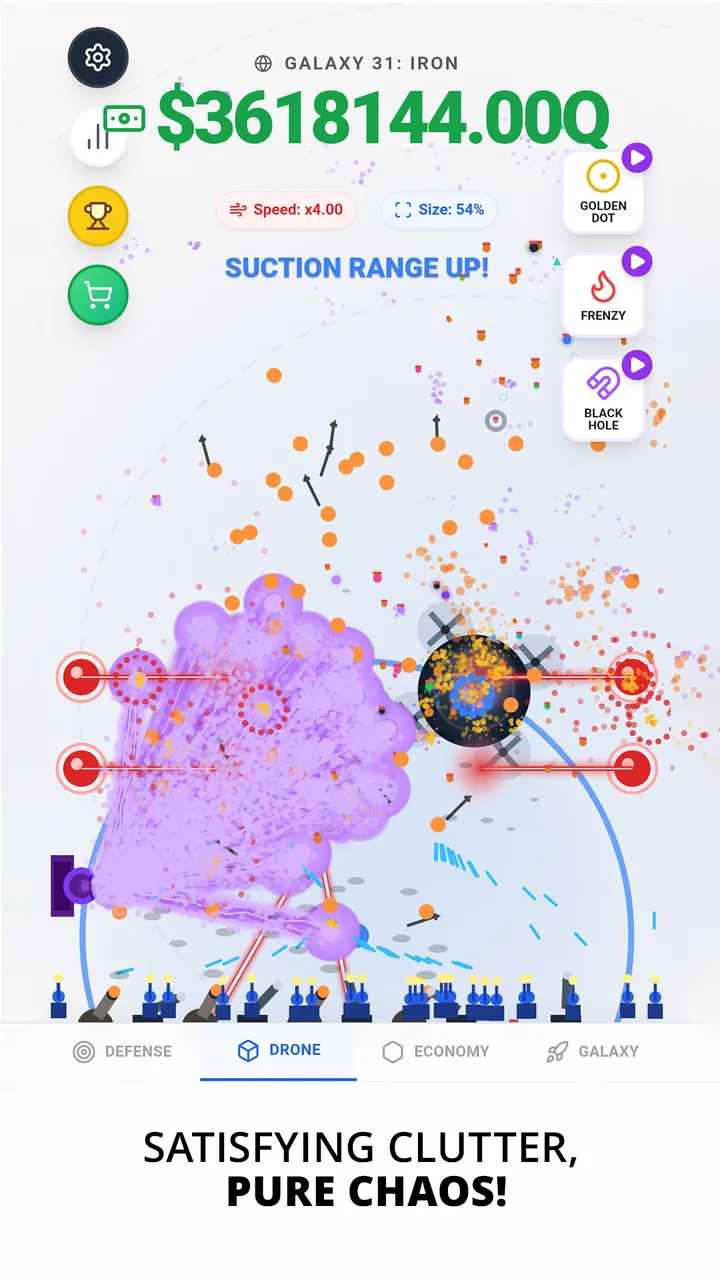
Idle Dot Shooter!
- 4.4
- Rating
- 1.00M
- Installs
- Free
- Price

 Analysis by App-foxy
I installed Idle Dot Shooter expecting a quick arcade distraction, and that is exactly where it makes the best first impression. The game puts a simple space-shooting idea in front of you: clear dots, improve your drones, and keep pushing upward on the leaderboard. There is very little ceremony before the action starts, which makes it easy to test during a spare minute rather than something I need to schedule time for.
That simplicity is also the main thing to understand before downloading it. This is not a story-driven space adventure or a precision shooter built around complicated controls. It is a lightweight idle arcade game focused on repeated progress. I found the pleasure in watching small improvements accumulate, checking what had changed since my last visit, and deciding where the next upgrade would have the most useful effect.
Infinity Games, Lda is behind the game, which is available for free and carries an Everyone age rating. It has attracted over 500 thousand installs, with an average score of 4.3 from around 7.8 thousand ratings. Those figures suggest that its straightforward format has found a sizeable audience, although the experience will depend heavily on how much you enjoy gradual repetition.
You May Also Like

 Blood Strike: 2.5 Anniversary
Blood Strike’s Loadouts Turn Every Drop Into a Tactical Gamble
A close look at Blood Strike’s custom loadouts: how fast access to signature weapons reshapes its battle royale rhythm, rewards preparation, and narrows the gap between fights.

 Pandora - Music & Podcasts
Pandora’s Music Is Easy to Start, but Harder to Recover
Pandora’s strength is its low-effort path from a seed to a station. Its weak spot is how much confidence it asks you to place in connection, setup, and quiet recovery.

 8 Ball Pool
 Is Built on Rivalries, Rematches, and Routine
A close look at the rivalries, rematches, shared routines, and unanswered safety questions that turn a quick pool match into a persistent mobile community.

 Samsung Music
’s Quiet Strength Is Playing What You Already Own
Its reach comes less from spectacle than from dependable access to a personal library. That simplicity is both the app’s strongest retention engine and its ceiling.

 AccuWeather: Weather Radar
AccuWeather Review: A Quick, Clear Forecast for Everyday Decisions
For everyday plans, the best forecast is the one you can understand quickly. AccuWeather makes rain timing, radar, and local conditions easy to act on, with a few trade-offs.

 Hill Climb Racing
Why Hill Climb Racing Still Turns Crashes Into One More Run
A tiny car, a bumpy hill and one more upgrade: Hill Climb Racing keeps resurfacing because its simple chaos makes every near-miss feel personal.
More From Our News Desk



How the short-session loop feels in practice
I find the short-session loop works best when I give each visit one small purpose instead of trying to turn it into a long arcade run. That keeps the repeated actions from feeling aimless and makes it easier to notice whether my progress is actually improving the next visit. From there, the useful question is which routine adjustments help me play more deliberately without expecting features the game does not offer.
A fast start with almost no learning burden
The strongest part of my first session was how quickly I understood the basic objective. The screen presents a space-themed target loop rather than asking me to learn a large set of controls or rules. I could begin clearing dots, see the effect of progress, and start thinking about upgrades without reading a long tutorial.
That immediate clarity matters for a game designed around brief visits. If I open it while waiting for a coffee or taking a short break, I do not want to reconstruct a complicated mission. The central action remains easy to recognize, and the drone upgrades give the session a clear direction. I am not simply tapping without purpose; I am trying to make the next return more productive.
The short description calls it an idle dot shooter, and that label is useful because it sets the right expectations. The game is closer to a progression toy than to a traditional arcade challenge. The attraction comes from the relationship between what is happening now and what the next upgrade may improve, not from mastering a demanding control scheme.
Immediate pleasure versus deeper challenge
I liked the small burst of satisfaction that comes from seeing a target disappear and then using the resulting progress to strengthen the setup. It is a clean, low-pressure form of feedback. The game does not need a large visual spectacle to make a short visit feel worthwhile; the basic loop is readable enough to provide a quick sense of movement.
At the same time, players looking for demanding reflex tests should be cautious. The appeal is not the same as a fast arcade shooter where every second depends on aiming accuracy, timing, or avoiding hazards. Here, the more interesting question is how to keep progression moving efficiently. That makes it relaxing, but it also means the game may feel too gentle if you want constant tension.
Why the drone upgrades matter
The drones are more than a decorative space detail because they give the repetition a planning layer. Whenever I considered an upgrade, I tried to think beyond the immediate number on the screen. A small improvement that helps the current stage may be less valuable than an option that makes later returns smoother, depending on how long I planned to keep playing.
My practical advice is to avoid spending every available resource automatically. Take a moment to notice whether an upgrade improves the part of the loop that is currently slowing you down. If clearing targets feels comfortable but progress between visits feels weak, the best decision may differ from the one that produces the biggest instant change. That kind of comparison is where the game gains more depth than its simple presentation suggests.
A useful routine for very short visits
For a one-minute session, I would check the current progress first, collect whatever the game has made available, and then make one deliberate upgrade decision before leaving. This prevents the visit from becoming aimless tapping. It also creates a small personal routine that works well when attention is divided.
For a longer break, I would spend more time comparing the effect of different improvements and checking whether the current pace feels satisfying. The game works best when I treat each visit as a small maintenance task rather than expecting a complete arcade round with a dramatic ending.
Returning after an interruption
Idle games live or die by how comfortable they are when the player steps away. In my experience, this one is naturally suited to interruption because its core idea does not demand that I protect a long uninterrupted run. I can leave after a short check and return later with the expectation that progress remains the main point of the visit.
That makes it a good companion for uneven schedules. Someone commuting, studying between tasks, or waiting for appointments can open it without committing to a full gaming session. The game asks for attention in small portions, and the space-shooter theme gives those portions enough identity to feel more engaging than a plain progress meter.
There is a trade-off, though. If you prefer games that remember a precise moment of action and reward careful continuous play, the idle structure may feel less personal. Stepping away is convenient, but it also reduces the importance of moment-to-moment skill. The design is forgiving because it is built around continuity, not because it offers a deep pause system that I would compare with a traditional campaign game.
How to make a return feel worthwhile
I found that returning with a specific purpose improved the experience. Instead of opening the game just to look at the screen, I would decide whether I wanted to strengthen the drones, push toward a leaderboard position, or simply clear a few more targets. That small intention makes the loop feel less repetitive.
It is also worth resisting the urge to judge the game after one very short visit. The appeal depends on seeing how several modest decisions connect. A single upgrade may not feel dramatic, but a sequence of sensible choices can make the next session noticeably more comfortable. This is a game for players who enjoy gradual momentum rather than instant transformation.
The repetition can be calming or limiting
The same loop that makes Idle Dot Shooter easy to understand can eventually become its biggest limitation. Clearing dots, improving drones, and chasing a higher position provide a dependable rhythm, but they do not automatically create variety. If I am in the mood for new environments, changing objectives, or a developing narrative, this format will not satisfy that need.
I see the repetition as useful when I want a predictable mental break. There is comfort in knowing what kind of task is waiting for me. The game does not demand that I remember a plot or rebuild a strategy from scratch. However, that same predictability means replay value depends on my personal interest in optimization and leaderboard progress.
The global leaderboard gives the loop a competitive target, but it is not equally important to everyone. Players who enjoy comparing long-term progress may find a reason to keep refining their upgrades. I personally found it more useful as an optional source of direction than as the entire purpose of the game. Without a strong interest in ranking, the experience becomes a private progression challenge, and that may be enough for casual players but not for competitive arcade fans.
Where it sits beside other arcade choices
Compared with a conventional arcade shooter, this game is easier to pick up and less demanding on reflexes. A traditional shooter is usually better when I want immediate pressure, precise input, and a clear sense that my performance during one run determines the result. Idle Dot Shooter is better when I want progress that can continue across several small visits.
It also differs from a pure idle app because the dot-shooting theme gives the progression a more active surface. I am not only watching an abstract resource increase; I have a visible target loop and drones that connect my upgrades to the space setting. Still, anyone wanting a rich management simulation may find the choices too focused, while someone seeking a fully hands-off idle experience may wonder why they need to interact at all.
For me, the most accurate comparison is a middle ground: more interactive than a passive progress screen, but much less demanding than a skill-heavy arcade game. That middle position is its strength for casual use and its weakness for players who want a strong identity at either extreme.
Free access and the payment decision
The game can be downloaded for free, with in-app purchases ranging from $0.99 to $99.99 per item. That range is important because it covers both small optional spending and much larger purchases. I would approach the shop carefully and decide in advance whether I am comfortable playing without buying anything or setting a firm personal limit.
The free entry makes it easy to test whether the loop suits you before spending money. My recommendation is to play long enough to discover whether the repetition itself is enjoyable. If the basic cycle already feels satisfying, optional purchases may remain unnecessary. If the cycle feels dull, paying to move through it faster is unlikely to solve the underlying problem.
Parents should also remember that an Everyone rating describes the content age level, not a promise that every purchase decision will be suitable for every household. Because the game includes in-app purchases, I would review device purchase controls before handing it to a child. That is a practical precaution, especially when a game is designed for frequent short visits.
Technical details that affect compatibility
The current version is 30.0.11, and the game requires Android 7.0 or later. That makes the minimum operating-system requirement relatively approachable for people using older compatible Android devices, although actual comfort will still depend on the phone or tablet and how smoothly it handles the game.
I would install it on the device where I am most likely to use it during spare moments. A phone is the natural fit because the sessions are brief, while a larger screen may be preferable if small targets or progress details are difficult to read. The key point is not raw screen size but whether the game feels convenient enough to reopen several times during the day.
Who should play it, and who should skip it
I would recommend it to someone who likes incremental upgrades, simple space themes, and games that tolerate interruptions. It is particularly suitable for players who want a low-commitment activity during commutes, queues, or short breaks. The clear loop also makes it approachable for people who do not want to learn a complicated arcade control system.
I would skip it if your priority is a substantial campaign, changing mission structures, or demanding real-time action. It is also a poor match if repetitive progression quickly loses its charm for you. The leaderboard may extend the experience for competitive players, but it cannot replace variety if what you really want is a series of distinct challenges.
Another group that should think twice is anyone who tends to spend impulsively in progression games. The free starting point is convenient, but the available purchase range means it is wiser to decide your boundaries before the upgrade loop becomes habitual.
My casual verdict after living with the loop
Idle Dot Shooter works best as a small, interruption-friendly arcade habit. I enjoyed it most when I had only a few minutes and wanted a clear action with a visible payoff. The dots are easy to understand, the drones give upgrades a practical purpose, and the leaderboard offers an extra reason to keep improving if competition appeals to me.
The experience is not built to surprise me every time I return. Its replay value comes from gradual progress and personal optimization, so the game asks me to enjoy repetition rather than tolerate it. That distinction is crucial: if the loop feels pleasant, the simplicity becomes a strength; if it feels monotonous, there is little else here to distract from that feeling.
With its free entry, Everyone rating, and modest Android requirement, it is easy to try. I would give it a chance when I want a calm space-themed time filler, keeping purchases optional and using short, purposeful sessions. I would choose a more traditional arcade shooter when I want sharper action, or a deeper idle game when I want broader systems to manage. For the right player, the best reason to keep playing is not spectacle but the satisfying habit of making each return slightly stronger.
After trying it, I would describe Idle Dot Shooter to a friend as a compact progression game rather than a full-scale shooter. It earns a place on my casual-play list because it starts quickly, survives interruptions well, and gives each brief visit a simple objective. I would not call it universally compelling, but for short-session clarity and low-pressure replay, it understands exactly what it wants to be.
FAQs for Idle Dot Shooter!
01What is Idle Dot Shooter! and how does it work?
Idle Dot Shooter! is a captivating idle game where players shoot dots to earn points and progress through levels. The game combines elements of strategy and timing, allowing players to upgrade their shooting abilities and unlock new levels. It's designed for both casual play and those looking to immerse themselves in a strategic gameplay experience.
02Is Idle Dot Shooter! free to play or are there in-app purchases?
Idle Dot Shooter! is free to download and play, making it accessible to everyone. However, it does offer optional in-app purchases that enhance gameplay, such as faster upgrades and exclusive levels. These purchases are not mandatory to enjoy the game but provide additional convenience and excitement for dedicated players.
03What platforms is Idle Dot Shooter! available on?
Idle Dot Shooter! is available on both Android and iOS platforms, ensuring a wide reach for mobile gamers. The game is designed to run smoothly on most smartphones and tablets, providing a seamless experience whether you're on an Android device or an iPhone.
04Does Idle Dot Shooter! require an internet connection?
Idle Dot Shooter! can be played offline, making it a great option for players who want to enjoy the game without an internet connection. However, certain features like leaderboards and in-app purchases do require a connection to function properly, so an internet connection enhances the full experience.
05What age group is Idle Dot Shooter! suitable for?
Idle Dot Shooter! is suitable for all age groups, featuring simple controls and non-violent gameplay. The game is designed to be engaging yet straightforward, making it ideal for younger players as well as adults looking for a relaxing yet challenging pastime. The content is family-friendly, ensuring a safe gaming environment for everyone.
Pros
- Simple and intuitive gameplay mechanics.
- Visually appealing with vibrant graphics.
- Regular updates with new levels.
- Offline play mode available.
- Minimal ads for uninterrupted play.
Cons
- Can become repetitive over time.
- Lacks in-depth tutorial for beginners.
- Limited customization options.
- In-app purchases can be pricey.
- Requires frequent updates for stability.

Idle Dot Shooter!
Gallery